Hello, fellow garden enthusiasts! Choosing the right tree for your yard is a big decision, a bit like choosing a long-term housemate. You want something that adds beauty and value, not trouble! While most trees are wonderful, some just aren’t suited for close quarters with our homes, driveways, and underground pipes.
Today, we’re going to dive into 20 common trees that, despite their charm, often bring more headaches than happiness when planted too close to our living spaces. This isn’t to say these trees are ‘bad’ – many are fantastic in the right setting, like a large park or a woodland edge. But for the average suburban yard or close to your foundation, it’s wise to think twice.
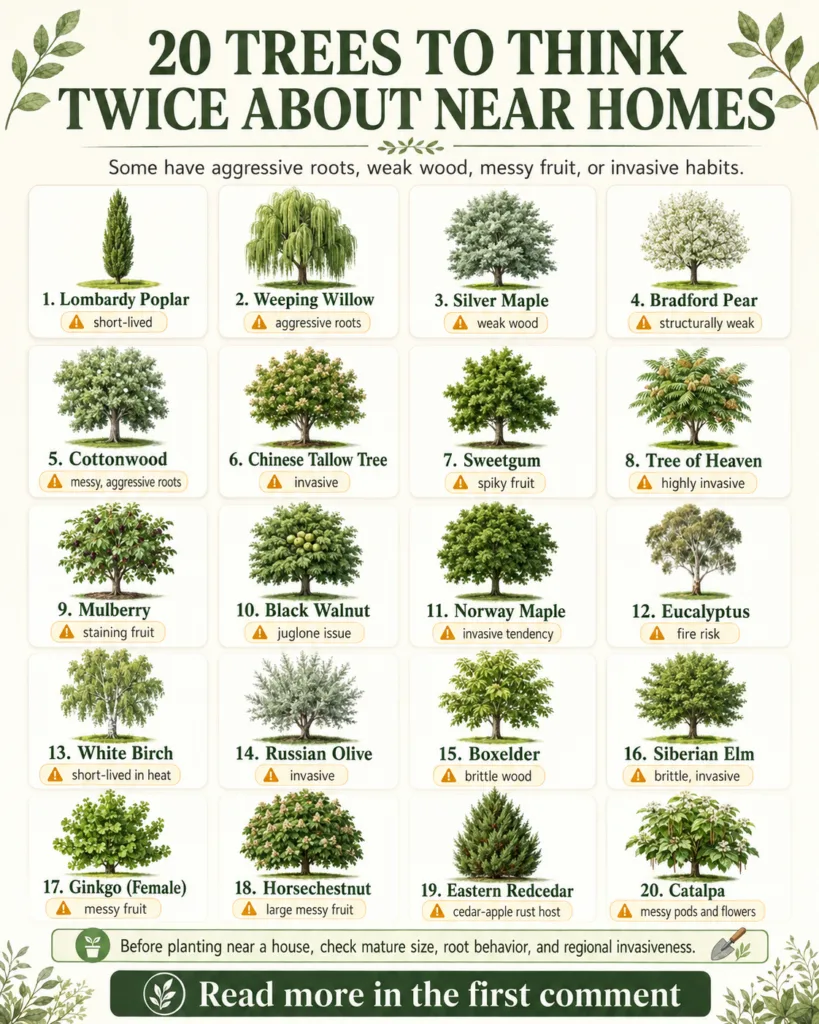 This infographic helps us visualize some common problematic trees.
Let’s explore why these trees might not be the best neighbors and what characteristics to keep an eye out for.
Understanding Tree Characteristics Near Homes
Before we list our 20 trees, let’s quickly touch on what makes a tree ‘problematic’ near a home:
- Aggressive Roots: Can damage foundations, sidewalks, driveways, and plumbing.
- Large Size: Can overshadow homes, drop debris, and pose a fall risk in storms.
- Weak Wood/Brittle Branches: Prone to breaking, especially during high winds or ice storms.
- Messy Debris: Fruits, seeds, leaves, or flowers that constantly litter your yard, gutters, or pool.
- Invasiveness: Spreads aggressively, outcompeting desired plants or becoming a nuisance.
- Pest/Disease Susceptibility: Can become sickly, requiring constant care or posing risks.
The 20 Trees to Reconsider Near Your Home
1. Silver Maple (Acer saccharinum)
- Height: Reaches 15-24 meters (50-80 ft), sometimes up to 36 meters (120 ft) in ideal conditions.
- Canopy: Broad, rounded crown, spreading 12-18 meters (40-60 ft) wide. Leaves are deeply lobed with a silvery underside.
- Growth Rate: Very fast (growing 0.9-2.1 meters or 3-7 ft per year).
- Habitat: Prefers moist, even wet soils; often found along riverbanks. Tolerant of various soil types and some drought.
Why Think Twice Near Homes:
Silver Maples grow incredibly fast, but this rapid growth often comes at a cost: weak wood. Their branches are prone to breaking in storms, posing a significant hazard to roofs, cars, and power lines. Their root systems are notoriously aggressive and shallow, often buckling sidewalks, cracking foundations, and invading sewer lines in search of water. They also drop a lot of seeds in spring.
If You Must (Tips for Management):
Plant at least 15-20 meters (50-70 ft) from any structure, driveway, or underground utility. Regular, professional pruning is essential to maintain a strong structure and remove weak limbs.
2. Bradford Pear (Pyrus calleryana ‘Bradford’)
- Height: Typically 7.5-12 meters (25-40 ft).
- Canopy: Dense, upright, and narrow when young, becoming more rounded with age, spreading 4.5-9 meters (15-30 ft). Known for abundant white flowers in spring.
- Growth Rate: Medium to fast (growing 0.3-0.6 meters or 1-2 ft per year).
- Habitat: Highly adaptable to a wide range of soils and climates, tolerant of urban pollution.
Why Think Twice Near Homes:
While beautiful in spring, Bradford Pears are notorious for their weak branch structure. Their narrow crotch angles make them very susceptible to splitting apart in high winds or ice storms, often causing significant damage. They also have a relatively short lifespan (15-25 years). Worse, they readily hybridize with other pear species, producing invasive offspring with thorns that colonize natural areas.
If You Must (Tips for Management):
Avoid planting near structures. If you have one, consider replacing it with a more structurally sound ornamental tree. Regular structural pruning from a young age can help, but it’s a constant battle.
3. Black Walnut (Juglans nigra)
- Height: 15-30 meters (50-100 ft), can reach 45 meters (150 ft).
- Canopy: Broad, rounded, open canopy, spreading 12-18 meters (40-60 ft). Large, compound leaves.
- Growth Rate: Medium (0.3-0.6 meters or 1-2 ft per year).
- Habitat: Prefers deep, fertile, moist, well-drained soils; often found in bottomlands and along streams.
Why Think Twice Near Homes:
Black Walnuts produce a chemical called juglone, which is toxic to many plants, inhibiting their growth (this is called allelopathy). This means gardening around a black walnut can be a frustrating experience. The large, hard, messy nuts drop in autumn, creating hazards for walking and mowing, and can damage vehicles or roofs. The tree also has a strong, deep root system.
If You Must (Tips for Management):
Plant at least 15 meters (50 ft) from other plants sensitive to juglone (tomatoes, blueberries, apples, pines, etc.). Be prepared for significant cleanup of nuts, or consider planting a tarp underneath during nut drop season.
4. Tree of Heaven (Ailanthus altissima)
- Height: 15-24 meters (50-80 ft), can reach 27 meters (90 ft).
- Canopy: Spreading, open, irregular crown, 9-15 meters (30-50 ft) wide. Large, compound leaves with a distinctive, unpleasant smell when crushed.
- Growth Rate: Extremely fast (0.9-3 meters or 3-10 ft per year).
- Habitat: Highly adaptable; thrives in poor, disturbed soils, urban environments, and can tolerate drought and pollution.
Why Think Twice Near Homes:
This tree lives up to its name in terms of height, but it’s a devil in disguise for homeowners. It’s incredibly invasive, spreading aggressively by seeds and root suckers, quickly forming dense thickets. Its roots are shallow and incredibly strong, capable of cracking pavement and foundations. The wood is weak, making it prone to breakage, and male trees emit an unpleasant odor during flowering. It’s often mistaken for sumac but is far more destructive.
If You Must (Tips for Management):
Frankly, it’s best to remove this tree. If you have one, immediate and persistent removal of suckers is crucial. Chemical treatment by a professional is often necessary to eradicate it.
5. Mimosa Tree (Albizia julibrissin)
- Height: 6-9 meters (20-30 ft).
- Canopy: Broad, flat-topped, umbrella-shaped crown, spreading 6-9 meters (20-30 ft) wide. Delicate, fern-like leaves and showy pink, puffy flowers.
- Growth Rate: Fast (0.6-1.2 meters or 2-4 ft per year).
- Habitat: Prefers full sun and well-drained soil; tolerant of heat and drought. Often found in disturbed areas.
Why Think Twice Near Homes:
The Mimosa tree is a beautiful, exotic-looking tree with its delicate leaves and fluffy pink blooms, but it’s often more trouble than it’s worth. It has weak wood, making it susceptible to storm damage. It’s also quite messy, dropping flowers, seed pods, and leaves throughout much of the year. In many regions, it’s considered invasive, spreading readily by seed and root suckers, outcompeting native vegetation. It’s also prone to vascular wilt disease.
If You Must (Tips for Management):
If you love the look, consider planting a sterile variety or planting it far from structures and regularly removing volunteers. Be prepared for cleanup.
6. Siberian Elm (Ulmus pumila)
- Height: 12-21 meters (40-70 ft).
- Canopy: Rounded, somewhat irregular crown, spreading 9-15 meters (30-50 ft) wide. Small, oval leaves.
- Growth Rate: Very fast (0.6-1.2 meters or 2-4 ft per year).
- Habitat: Extremely hardy and adaptable; tolerates drought, poor soils, wind, and urban pollution.
Why Think Twice Near Homes:
Often touted for its hardiness and fast growth, the Siberian Elm is a problematic tree near homes. Its wood is weak and brittle, leading to frequent limb breakage in wind or ice. It produces an abundance of seeds that sprout everywhere, making it highly invasive and difficult to control. It’s also susceptible to various pests and diseases, and its shallow, fibrous root system can be disruptive.
If You Must (Tips for Management):
Avoid planting if possible. If you inherit one, regular, careful pruning can help mitigate the weak branch structure. Be vigilant about removing seedlings that pop up.
7. Poplars (Populus species, e.g., Lombardy Poplar)
- Height: Varies greatly by species, but many reach 15-30 meters (50-100 ft).
- Canopy: Can be columnar (Lombardy Poplar) or broad and spreading, 4.5-15 meters (15-50 ft) wide.
- Growth Rate: Extremely fast (0.9-2.4 meters or 3-8 ft per year).
- Habitat: Prefer moist, well-drained soils; often found near water. Tolerant of a range of conditions.
Why Think Twice Near Homes:
Poplars are known for their incredibly fast growth, but this speed often comes with weak, brittle wood that breaks easily in storms. They are also notorious for their aggressive, far-reaching root systems that can invade drainpipes, foundations, and septic systems. Many species produce copious amounts of cottony seeds that can be a nuisance. They also tend to be short-lived and susceptible to numerous diseases and pests.
If You Must (Tips for Management):
Plant very far from any structures or underground utilities. Consider them only for very large properties where their invasive roots and potential for breakage won’t cause problems.
8. Weeping Willow (Salix babylonica)
- Height: 7.5-15 meters (25-50 ft).
- Canopy: Broad, weeping form, spreading 7.5-15 meters (25-50 ft) wide. Long, pendulous branches.
- Growth Rate: Fast (0.6-1.2 meters or 2-4 ft per year).
- Habitat: Thrives in moist to wet soils; often planted near water features.
Why Think Twice Near Homes:
Weeping Willows are undeniably beautiful with their graceful, drooping branches, but they are incredibly thirsty trees. Their root systems aggressively seek out water, making them a huge threat to septic systems, drain fields, and underground pipes. Their wood is also soft and brittle, leading to frequent limb breakage in storms. They can be messy with falling twigs and leaves, and they tend to have a shorter lifespan than many other trees.
If You Must (Tips for Management):
Only plant if you have a very large property and can place it at least 25-30 meters (80-100 ft) from any structures or utilities, ideally near a natural pond or stream. Be prepared for cleanup and potential limb damage.
9. Cottonwood (Populus deltoides)
- Height: 24-30 meters (80-100 ft), can exceed 45 meters (150 ft).
- Canopy: Broad, open, somewhat irregular crown, spreading 15-24 meters (50-80 ft) wide.
- Growth Rate: Extremely fast (0.9-2.4 meters or 3-8 ft per year).
- Habitat: Prefers moist, well-drained soils; commonly found along rivers and streams.
Why Think Twice Near Homes:
Similar to other poplars, Cottonwoods grow massive and incredibly fast, but their wood is weak and prone to decay, leading to dangerous limb drops, especially in storms. Their extensive and shallow root systems are highly aggressive, known for buckling pavement, disrupting foundations, and invading plumbing. Female trees produce a prolific amount of ‘cotton’ in late spring/early summer, which can be a significant nuisance, coating everything in its path.
If You Must (Tips for Management):
Best suited for very large, open spaces, far from any structures or utilities. If you have one, consider a male cultivar if cotton is an issue, but the root and weak wood problems persist.
10. Empress Tree / Paulownia (Paulownia tomentosa)
- Height: 9-15 meters (30-50 ft).
- Canopy: Broad, rounded crown, spreading 7.5-12 meters (25-40 ft) wide. Very large, heart-shaped leaves and showy purple flowers.
- Growth Rate: Extremely fast (1.2-3 meters or 4-10 ft per year), especially when young.
- Habitat: Adaptable to poor soils, urban conditions, and drought.
Why Think Twice Near Homes:
The Empress Tree, or Foxglove Tree, is beautiful with its large leaves and fragrant purple flowers, but it’s a very aggressive invasive species in many parts of the world. It grows incredibly fast, outcompeting native plants. Its wood is brittle, making it susceptible to storm damage. It produces millions of tiny seeds that spread widely, and it also re-sprouts vigorously from roots after being cut down, making it extremely difficult to eradicate. It can take over quickly.
If You Must (Tips for Management):
It’s generally advised not to plant this tree. If you have one, consider removal and ongoing vigilance to remove re-sprouts and seedlings.
11. Eucalyptus (Eucalyptus species, e.g., Blue Gum)
- Height: Varies greatly by species, many are very tall, 30-60 meters (100-200 ft) or more.
- Canopy: Open, often irregular crown. Can be broad or narrow depending on species. Distinctive aromatic leaves.
- Growth Rate: Very fast (1.2-3 meters or 4-10 ft per year in ideal conditions).
- Habitat: Prefers warm climates; various soil tolerances depending on species, but many like well-drained soils.
Why Think Twice Near Homes:
Eucalyptus trees, particularly larger varieties like Blue Gum, are problematic for several reasons. Many species grow incredibly tall, making them a significant fall hazard in high winds. Their wood can be brittle, and large branches are prone to shedding unexpectedly, even in calm weather. They have aggressive, shallow root systems that can damage foundations and pavement. In dry climates, their high oil content makes them a significant fire hazard.
If You Must (Tips for Management):
Only consider planting dwarf or smaller ornamental varieties in suitable climates, far from structures. Regular professional assessment and pruning are crucial for safety.
12. Sweetgum (Liquidambar styraciflua)
- Height: 18-24 meters (60-80 ft), can reach 36 meters (120 ft).
- Canopy: Pyramidal when young, becoming more oval to rounded with age, spreading 12-15 meters (40-50 ft) wide. Star-shaped leaves with brilliant fall color.
- Growth Rate: Medium to fast (0.3-0.6 meters or 1-2 ft per year).
- Habitat: Prefers moist, acidic, well-drained soils.
Why Think Twice Near Homes:
Sweetgum trees are beautiful, especially with their stunning fall foliage, but they come with a notorious downside: their spiky, golf-ball-sized seed pods. These pods drop by the thousands, creating a significant tripping hazard and making walking or mowing a nightmare. They can also damage lawnmowers. Furthermore, Sweetgums have a strong, shallow root system that can lift sidewalks and driveways.
If You Must (Tips for Management):
Consider only a fruitless cultivar if available. Otherwise, plant far from walkways, patios, and homes. Be prepared for extensive cleanup of the spiky seed pods.
13. Norway Maple (Acer platanoides)
- Height: 12-18 meters (40-60 ft).
- Canopy: Dense, rounded crown, spreading 12-15 meters (40-50 ft) wide. Large, dark green leaves.
- Growth Rate: Medium to fast (0.3-0.6 meters or 1-2 ft per year).
- Habitat: Highly adaptable to urban conditions, pollution, and various soil types.
Why Think Twice Near Homes:
Norway Maples were once popular street trees due to their hardiness, but they are now recognized as an invasive species in many regions. Their dense canopy casts heavy shade, making it difficult for other plants to grow underneath. They have shallow, aggressive root systems that compete with nearby plants and can lift sidewalks and foundations. They also produce abundant seeds that readily sprout, outcompeting native trees.
If You Must (Tips for Management):
It’s generally advised to avoid planting this tree. If you have one, prune regularly to allow more light, and be diligent about removing seedlings.
14. Leyland Cypress (Cupressocyparis leylandii)
- Height: Can reach 15-24 meters (50-80 ft), sometimes taller.
- Canopy: Narrow, columnar, dense evergreen foliage, spreading 4.5-6 meters (15-20 ft) wide.
- Growth Rate: Very fast (0.9-1.2 meters or 3-4 ft per year).
- Habitat: Adaptable to various soils, prefers full sun.
Why Think Twice Near Homes:
Leyland Cypress is often chosen for privacy hedges due to its rapid growth and dense foliage. However, it grows very tall and wide, quickly becoming too large for many residential spaces. Its rapid growth makes its wood somewhat brittle, and it’s prone to internal rot and disease (like Seiridium canker) once it gets large, especially when planted too close together in hedges. Its shallow roots can be surface-level and expansive. When diseased, they can become unsightly and even fall over.
If You Must (Tips for Management):
If used as a hedge, plant them with ample space (at least 3-4 meters apart) and prune regularly from a young age to control size and maintain health. Ensure good air circulation.
15. Russian Olive (Elaeagnus angustifolia)
- Height: 3-6 meters (10-20 ft), sometimes taller.
- Canopy: Broad, rounded, somewhat open crown, spreading 3-6 meters (10-20 ft) wide. Silvery-green leaves, thorny branches, and small, fragrant yellow flowers followed by olive-like fruits.
- Growth Rate: Medium to fast (0.3-0.6 meters or 1-2 ft per year).
- Habitat: Extremely tough and adaptable; tolerates drought, poor soils, and saline conditions.
Why Think Twice Near Homes:
Russian Olive might seem charming with its silvery leaves and fragrant flowers, but it’s a highly invasive species. It outcompetes native vegetation, forming dense thickets that reduce biodiversity. Its thorny branches can be a hazard, and it produces abundant fruit that spreads easily by birds. It also has a competitive root system and can be difficult to remove once established.
If You Must (Tips for Management):
It’s best to avoid planting this tree. If you have one, regularly remove it to prevent fruit production and spread. Professional removal might be necessary for established trees.
16. Catalpa (Catalpa speciosa)
- Height: 12-18 meters (40-60 ft).
- Canopy: Open, irregular, broad, and rounded crown, spreading 9-15 meters (30-50 ft) wide. Very large, heart-shaped leaves and showy white flowers.
- Growth Rate: Fast (0.6-0.9 meters or 2-3 ft per year).
- Habitat: Adaptable to various soils, including wet and dry, and urban conditions.
Why Think Twice Near Homes:
Catalpas are beautiful with their large leaves and orchid-like flowers, but they can be incredibly messy. They drop copious amounts of flowers in late spring, followed by long, bean-like seed pods that hang on through winter and fall the following spring. This creates a prolonged period of debris cleanup. Their wood can be brittle, and they are prone to various pests like the Catalpa sphinx moth, which defoliates the tree, leaving droppings underneath.
If You Must (Tips for Management):
Plant far from patios, driveways, and gutters. Be prepared for extensive cleanup of flowers, leaves, and seed pods. Regular pruning can help maintain a strong structure.
17. Mulberry (Morus species)
- Height: Varies by species, often 6-15 meters (20-50 ft).
- Canopy: Rounded, spreading crown, often wider than tall, 7.5-12 meters (25-40 ft) wide.
- Growth Rate: Fast (0.6-0.9 meters or 2-3 ft per year).
- Habitat: Adaptable to various soils and conditions.
Why Think Twice Near Homes:
Mulberry trees, especially fruiting varieties, are incredibly messy. Their dark, juicy berries drop over an extended period, staining sidewalks, driveways, cars, and anything underneath them (including clothes and pets!). Birds are highly attracted to the fruit, which means even more mess from bird droppings. Some species are also considered invasive, spreading readily by seed. They can also have aggressive root systems.
If You Must (Tips for Management):
Consider a fruitless male cultivar. If you have a fruiting one, plant it far from any paved surfaces, clothing lines, or areas where staining is an issue. Be prepared for significant cleanup during fruiting season.
18. Boxelder (Acer negundo)
- Height: 9-15 meters (30-50 ft).
- Canopy: Broad, irregular, rounded crown, spreading 7.5-12 meters (25-40 ft) wide. Compound leaves, unusual for a maple.
- Growth Rate: Very fast (0.6-1.2 meters or 2-4 ft per year).
- Habitat: Highly adaptable; tolerates wet soils, drought, and urban pollution. Often found in disturbed areas.
Why Think Twice Near Homes:
Boxelders are another fast-growing maple with weak, brittle wood, making them prone to storm damage and limb breakage. They are often considered ‘weedy’ or ‘trash trees’ due to their rapid, sometimes ungainly growth and tendency to self-seed aggressively. They are also famous for attracting boxelder bugs, which can become a nuisance when they gather on homes in autumn, seeking warmth. Their roots can be aggressive.
If You Must (Tips for Management):
Best to avoid. If present, regular pruning can help remove weak wood. Consider controlling boxelder bug populations with appropriate, safe methods if they become a problem.
19. Ash Tree (Fraxinus species)
- Height: Varies by species, often 15-24 meters (50-80 ft).
- Canopy: Oval to rounded crown, spreading 9-15 meters (30-50 ft) wide.
- Growth Rate: Medium to fast (0.3-0.6 meters or 1-2 ft per year).
- Habitat: Prefer moist, well-drained soils, but adaptable.
Why Think Twice Near Homes:
While historically beautiful and sturdy trees, Ash trees are currently under severe threat from the Emerald Ash Borer (EAB), an invasive insect that has devastated Ash populations across North America. Planting an Ash tree now means almost certain death from EAB unless you commit to costly, ongoing preventative chemical treatments, which may not always be effective. Dead or dying Ash trees pose a significant safety risk near homes due to falling limbs.
If You Must (Tips for Management):
It is generally not recommended to plant Ash trees unless you are in an area not affected by EAB or are committed to a long-term treatment plan. If you have existing Ash trees, consult an arborist about EAB prevention or removal if infested.
20. Eastern Redcedar (Juniperus virginiana)
- Height: 12-15 meters (40-50 ft), can reach 24 meters (80 ft).
- Canopy: Dense, conical to columnar, evergreen, spreading 3-6 meters (10-20 ft) wide.
- Growth Rate: Slow to medium (0.15-0.3 meters or 0.5-1 ft per year).
- Habitat: Extremely adaptable; tolerates poor, dry soils, full sun, and various climates.
Why Think Twice Near Homes:
Eastern Redcedar itself is a tough, native tree. However, it’s a primary host for cedar-apple rust, a fungal disease that requires both a cedar (or juniper) and an apple or crabapple tree to complete its life cycle. If you or your neighbors grow apple or crabapple trees, planting an Eastern Redcedar nearby will almost certainly lead to unsightly and damaging rust infections on the fruit trees. They also produce abundant small, blue berries that birds love, but which can be somewhat messy.
If You Must (Tips for Management):
Avoid planting within 800 meters (0.5 miles) of apple or crabapple trees to prevent the spread of cedar-apple rust. Otherwise, they are low-maintenance and can be good screening plants in appropriate locations.
Final Thoughts: Planting Smart for a Happy Home
Choosing the right tree is an investment in your home and garden’s future. It’s about finding a balance between beauty, function, and avoiding future headaches. By being aware of a tree’s mature size, root behavior, wood strength, and potential for mess or invasiveness, you can make informed decisions that benefit everyone – especially your home and your wallet!
Always do a little research before you dig, and if you’re ever unsure, don’t hesitate to chat with a local arborist or nursery expert. Happy planting!