Supplement charts online make it look simple: take this for stress, that for muscle, and you’ll see fast results. But the truth is more nuanced.
Some supplements have strong evidence (especially for training performance). Others can help only in specific situations (like true nutrient deficiency). And a few are popular mostly because they sound like a shortcut.
Most people never realize this because they expect a supplement to “fix” a problem that actually needs a routine: sleep + protein + training + skincare consistency.
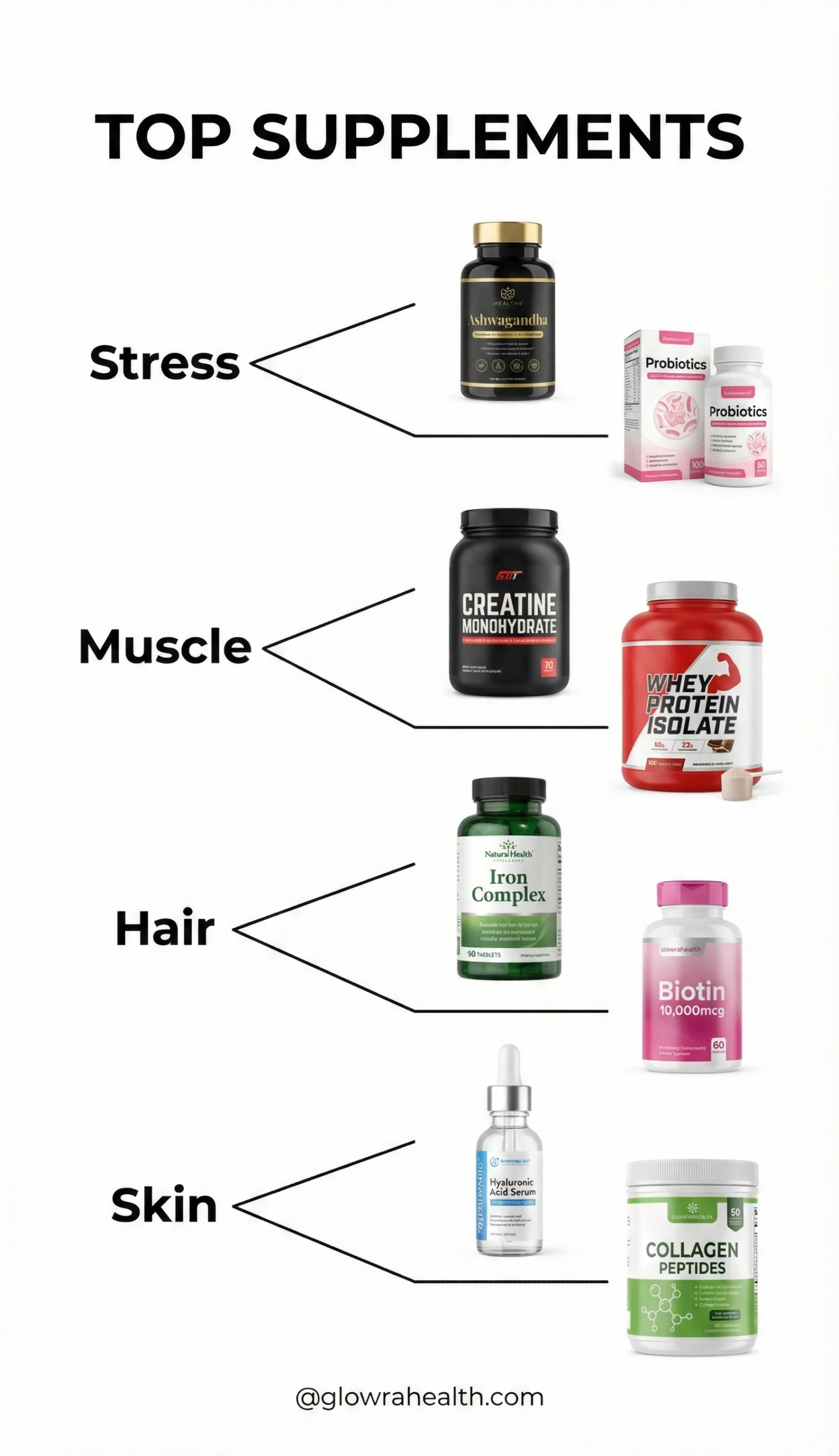
1) Ashwagandha (for stress) — Moderate evidence
Ashwagandha is an adaptogenic herb studied for perceived stress and anxiety. Systematic reviews and NIH’s Office of Dietary Supplements (ODS) summarize that some trials show reductions in stress/anxiety scores and cortisol, but results vary by extract, dose, and study quality.
How to use (typical research range):
- Often ~240–600 mg/day of standardized extract for 6–8 weeks (varies by product/study).
Safety notes (important):
- Avoid in pregnancy.
- Use caution with thyroid conditions and if you take thyroid meds.
- Rare cases of liver injury have been reported; stop if you develop unusual fatigue, dark urine, or jaundice and seek care.
Realistic timeline: 2–8 weeks.
2) Probiotics (for stress) — Mixed, strain-specific evidence
Probiotics are being studied for mood and stress via the gut–brain axis. Meta-analyses suggest small-to-moderate improvements in some depression/anxiety measures, but effects depend heavily on the strain, dose, and population, and results are not guaranteed.
Practical takeaways:
- Look for a product that lists specific strains (not just “proprietary blend”).
- Evaluate based on your symptom goal (bloating vs. anxiety vs. bowel regularity).
Safety notes:
- If you’re immunocompromised or critically ill, ask your clinician first.
Realistic timeline: 2–6 weeks (if it helps).
3) Creatine Monohydrate (for muscle) — Strong evidence
Creatine is one of the most consistently supported supplements for strength, power, and lean mass gains when paired with resistance training. Recent meta-analyses continue to show performance benefits across populations.
How to use (simple approach):
- 3–5 g daily (no loading needed for most people).
Safety notes:
- Generally considered safe for healthy adults at common doses, but if you have kidney disease or unexplained high creatinine, talk with your clinician before starting. (Creatine can raise blood creatinine because creatinine is a breakdown product – this does not automatically mean kidney damage, but it can confuse labs.)
Realistic timeline: Strength improvements often show in 2–4 weeks, with best changes over 8–12 weeks + training.
4) Whey Protein Isolate (for muscle) — Strong evidence when training + daily protein are in place
Whey protein is not magic – it’s simply an efficient way to hit your daily protein target. The International Society of Sports Nutrition (ISSN) notes that adequate protein supports muscle repair and hypertrophy, especially with resistance training.
How to use (simple):
- Use whey as a tool, not a requirement.
- Many active adults do well aiming roughly 1.6 g/kg/day protein (individual needs vary with goals, age, and training).
Safety notes:
- If you have lactose sensitivity, isolate is often easier – but still check tolerance.
- If you have kidney disease, follow your clinician’s protein guidance.
Realistic timeline: 4–12 weeks (with consistent training).
5) Iron Complex (for hair) — Helpful only if you’re deficient
Iron deficiency can contribute to hair shedding in some people. NIH ODS emphasizes the importance of appropriate intake, but also warns that excess iron can be harmful—so supplementation should be based on labs and medical guidance.
Best practice:
- Ask for labs such as ferritin and iron studies before supplementing.
- If deficient, correcting iron status may support regrowth over time.
Safety notes (critical):
- Too much iron can cause iron overload in some conditions; do not “self-dose” high iron long-term.
Realistic timeline: 8–16+ weeks (hair cycles are slow).
6) Biotin (10,000 mcg) (for hair) — Overhyped unless deficient
Biotin deficiency can cause hair and skin issues, but true deficiency is uncommon. NIH ODS notes that evidence for biotin supplements improving hair/nails in healthy people is limited, while high-dose biotin can interfere with lab tests (thyroid, troponin, etc.).
Practical takeaways:
- If you suspect deficiency, address the cause (diet, medications, malabsorption) rather than megadosing.
- If you take high-dose biotin, tell your healthcare team before blood tests.
Realistic timeline: If deficient, improvement can take months. If not deficient, you may notice no change.
7) Hyaluronic Acid Serum (topical – for skin ) — Good evidence for hydration/plumping (temporary)
Topical hyaluronic acid is a humectant that helps pull water into the skin, improving hydration and a “plumper” look. Clinical research shows improvements in hydration and appearance with consistent use.
How to use for best results:
- Apply to slightly damp skin, then seal with moisturizer.
- Use daily, especially in dry climates.
Realistic timeline: Immediate “plump” feel, more visible improvement in 2–4 weeks.
8) Collagen Peptides (oral – for skin) — Promising, but results are modest and quality varies
Systematic reviews/meta-analyses suggest hydrolyzed collagen may improve skin hydration and elasticity, and sometimes wrinkles—typically over 8–12 weeks. However, some reviews note that funding source and study quality can influence results, so treat claims as “helpful for some” rather than guaranteed.
How to use (common ranges in trials):
- Often 2.5–10 g/day, depending on product and study design.
Realistic timeline: 8–12 weeks.
Quick Safety Notes
- Supplements can interact with medications and conditions. If you’re pregnant, immunocompromised, have thyroid disease, kidney disease, or unexplained lab changes – check with a clinician first.
- More is not better. Especially with iron and high-dose biotin.
When You’ll Notice Changes (Quick Relief Timeline)
- Skin hydration (HA serum): same day → best in 2–4 weeks
- Stress (ashwagandha/probiotics): 2–8 weeks
- Muscle (creatine/whey + training): 2–12 weeks
- Hair (iron/biotin if deficient): 8–16+ weeks
Science Sources
- NIH ODS: Ashwagandha fact sheet (ods.od.nih.gov)
- Systematic review/meta-analysis: Ashwagandha for stress/anxiety (Cambridge University Press & Assessment)
- Meta-analyses: Probiotics and mood/anxiety outcomes (OUP Academic)
- Meta-analyses: Creatine and strength/performance (peerj.com)
- ISSN position stand: Protein and exercise (Springer)
- NIH ODS: Iron fact sheet (ods.od.nih.gov)
- NIH ODS: Biotin fact sheet (lab test interference) (ods.od.nih.gov)
- Clinical study: Topical hyaluronic acid serum for photoaging (Springer)
- Meta-analysis: Oral collagen peptides for skin hydration/elasticity (MDPI)